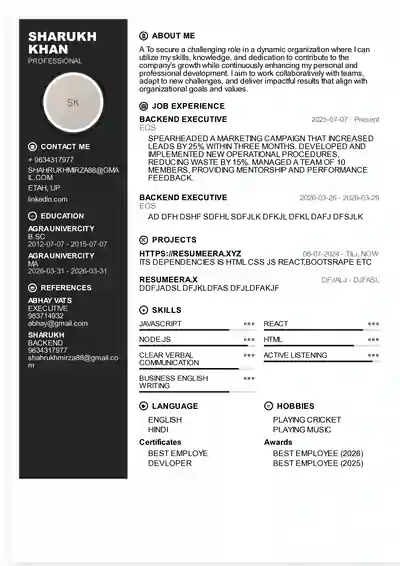
A modern resume in 2026 is not about fancy colours or designer graphics. Indian recruiters and hiring managers spend less than seven seconds on the first scan, and before that, your resume must pass an Applicant Tracking System. Whether you apply through Naukri, LinkedIn Easy Apply, Indeed, or a company career portal powered by TCS iON, SAP SuccessFactors, Oracle Taleo or Workday, the ATS parses your file first. If it cannot read your headings, dates, or skills, you are filtered out before a human sees your profile. This guide explains modern resume design that is both visually professional for recruiters and fully ATS-safe for 2026. You will learn exact formatting rules, section order, font choices, and keyword placement that work for freshers, experienced professionals, and career switchers in India. You will also get a free ATS-safe professional template and builder at ResumeEra.xyz to create and download your resume in minutes without worrying about layout errors.
What Makes a Resume ATS-Safe in 2026?
An ATS-safe resume is one that both software and humans can read without confusion. In 2026, most mid and large companies in India use an ATS to collect, parse, and rank resumes. Startups hiring through Naukri FastForward, Cutshort, or LinkedIn Recruiter also depend on automated parsing. The system extracts your name, contact details, work experience, education, and skills into structured fields. A modern design keeps this extraction accurate while still looking clean and professional to a recruiter. ATS-safe does not mean plain or boring. It means using standard headings, logical reading order, searchable text, and no elements that block parsing. A resume with text boxes, images, icons, tables for layout, or headers and footers often fails parsing. The ATS may skip your experience or mix your skills, which lowers your match score. A modern ATS-safe design uses a single column or a very clean two-column layout with clear section dividers, adequate white space, and consistent formatting so that every detail is captured correctly.
How ATS Actually Reads Your Resume
The ATS does not see your resume like a human. It reads it as raw text from top to bottom, left to right. It looks for standard headings such as Work Experience, Education, Skills, and Projects to assign information to the right database fields. When you upload a PDF or DOCX to a company portal, the parser first strips formatting and then scans for keywords from the job description, including job titles, tools, degrees, and certifications. It also checks for chronological consistency, location, and employment dates. If your heading is written as My Journey instead of Work Experience, the ATS may not recognise it and may place that content under the wrong category or ignore it. Similarly, if your skills are inside an image or a graphic rating bar, the ATS reads nothing. Modern ATS in 2026 also uses semantic matching, so it understands variations like Digital Marketing and Performance Marketing if the context is clear, but exact keyword matches still rank higher. Keeping your file as selectable text, not a scanned image, is essential.
ATS Software Commonly Used by Indian Employers
Indian employers use a mix of global and local ATS platforms. Large IT services companies such as TCS, Infosys, Wipro, and Cognizant use Taleo, SuccessFactors, or Workday. Product companies and GCCs often use Greenhouse or Lever. Many Indian SMEs and recruitment consultancies use Naukri RMS, Zoho Recruit, Keka, and Darwinbox. All of these systems have similar parsing rules, but Naukri RMS is especially sensitive to formatting because it powers the Naukri database where lakhs of resumes are searched daily by recruiters using Boolean keywords. If your resume is not optimised for Naukri search, you will not appear in recruiter searches even if you are qualified. LinkedIn Recruiter also parses your uploaded resume and matches it against profile data, so consistency between your LinkedIn profile and resume improves visibility. The common factor across all these tools is that they prefer simple, text-based resumes with clear headings, reverse-chronological order, and relevant keywords placed naturally in your experience bullets and skills section.
Modern Resume Design Principles That Recruiters Prefer in India
Recruiters in India review hundreds of resumes for a single opening, especially for fresher and analyst roles. A modern design helps them find information in seconds without eye strain. The best modern resumes in 2026 follow a minimalist professional style. They use one or two professional fonts such as Inter, Calibri, Garamond, or Poppins, with font size 10 to 11 for body text and 13 to 16 for your name. Colour is used sparingly, only for your name or section dividers in navy, dark grey, or teal, never for full backgrounds. Margins are kept between 0.5 and 0.7 inches to balance white space and content density. Line spacing is 1.0 to 1.15, and sections are separated by thin horizontal lines rather than boxes or shading. This approach looks premium when printed or viewed on mobile, which is important because many Indian recruiters first view resumes on phones via Naukri or LinkedIn apps. A modern design also prioritises achievements over duties, using bullet points that start with action verbs and include numbers.
Visual Hierarchy Without Graphics
Visual hierarchy means guiding the recruiter's eyes to the most important information first. You can achieve this without graphics, icons, or progress bars, which often confuse the ATS. Use size, weight, and spacing instead. Your name should be the largest text on the page, followed by section headings in bold and slightly larger font. Job titles should be bold, company names in regular weight, and dates aligned to the right for quick scanning. Keep all headings in the same style and use consistent bullet symbols. For skills, use a simple comma-separated list or a clean bullet list grouped by category such as Programming: Python, Java, SQL or Marketing: SEO, Google Ads, Meta Ads. Avoid rating skills with stars or percentages, as recruiters find them subjective and the ATS cannot interpret them. White space is your best design tool. A resume that is crowded signals poor communication, while one with balanced spacing looks confident and organised. This hierarchy works perfectly for both a fresher with one page and an experienced professional with two pages.
- Font discipline: Use one font family throughout. Do not mix decorative fonts.
- Colour restraint: Use one accent colour for headings or lines. Avoid bright backgrounds.
- Alignment consistency: Left-align all body text. Right-align dates for easy scanning.
- Bullet uniformity: Use simple round or dash bullets. Avoid arrows or custom icons.
- Section order logic: Place the strongest section after summary. Freshers put Education and Projects first, experienced put Work Experience first.
Modern vs Traditional vs Creative: Which Design Gets Shortlisted?
Not every design performs equally in ATS and with Indian recruiters. A traditional resume is very plain, often using Times New Roman, dense paragraphs, and no spacing. A creative resume uses infographics, photos, charts, and multi-column layouts. A modern resume sits in the middle, clean, professional, and ATS-optimised. For corporate jobs, IT, banking, consulting, and government-adjacent roles, modern is the safest and most effective. Creative designs are only suitable for portfolio roles such as graphic designer or UI/UX where a PDF portfolio is expected alongside a separate ATS resume.
| Feature | Traditional Resume | Modern ATS-Safe Resume | Creative Infographic Resume |
|---|---|---|---|
| ATS Parse Rate | High but looks outdated | Very High, 95%+ accuracy | Low, often fails to parse |
| Recruiter Impression in India | Dull, hard to scan | Professional, easy to scan | Distracting for non-design roles |
| Best For | Government or very conservative firms | IT, Finance, Marketing, Fresher, Experienced | Design, Photography, Fashion |
| Layout | Single column, dense text | Clean single column with white space | Multi-column with icons and charts |
| File Compatibility | Good | Excellent for Naukri and LinkedIn | Poor, often rejected |
| Time to Shortlist | Moderate | Fastest | Slowest due to manual review needed |
For most job seekers in India, a modern ATS-safe design gives the best return. It passes automated filters and still impresses hiring managers who expect a contemporary, well-structured document. If you are applying to a design agency, you can keep a creative portfolio PDF separately and still submit a modern ATS resume for the application portal. This dual approach ensures you are not filtered out before your work is seen.
Step-by-Step: Build an ATS-Safe Modern Resume on ResumeEra.xyz
You do not need design software to create a modern resume. The free builder at ResumeEra.xyz provides ATS-tested templates that handle formatting automatically so you can focus on content. Follow these steps to build a job-ready resume in under 15 minutes.
- Choose the modern ATS template: Open https://resumeera.xyz and select a modern template labelled ATS-safe. These templates use single-column structure, standard headings, and no text boxes, so parsing is accurate.
- Add header with searchable contact details: Enter your full name, phone number, professional email, city and state, LinkedIn URL, and portfolio or GitHub link if relevant. Avoid putting contact details in header or footer sections.
- Write a tailored professional summary: In 3 to 4 lines, include your role, years of experience, core skills, and one measurable achievement. Customise this for each job by mirroring keywords from the job description.
- Enter work experience in reverse order: For each role, add job title, company name, location, and dates in MM/YYYY format. Write 3 to 5 bullets starting with action verbs and include numbers, such as increased sales by 22 percent or reduced query time by 40 percent.
- List education and certifications clearly: Add degree, specialisation, university, year of passing, and CGPA if you are a fresher. Add relevant certifications such as AWS, Google Analytics, or NISM with completion year.
- Add skills grouped by category: Create groups like Technical Skills, Tools, and Soft Skills. Use exact terms from the job posting, for example SQL not Structured Query Language if the posting says SQL.
- Include projects or internships for freshers: Add project title, tech stack, and 2 to 3 bullets explaining problem, action, and result. For internships, mention duration and key contribution.
- Preview, check ATS score, and download: Use the built-in ATS score preview to check keyword match and formatting issues. Fix any warnings, then download as PDF and DOCX. Keep file name as YourName_Role_Resume.pdf for recruiter searches.
Section-Wise Formatting Rules for Maximum ATS Score
Each section of your resume has specific formatting rules that affect ATS scoring. Follow these rules consistently to avoid parsing errors and to improve your match percentage on Naukri and company portals.
Header: Keep your name on the first line, largest font. Do not include photo, date of birth, gender, or full home address. For Indian applications, city and state are enough. Ensure email is professional and phone number includes +91 if applying to MNCs.
Professional Summary: Place it right below the header. Keep it concise and keyword-rich. For a fresher, mention degree, internship, and career objective with skills. For experienced, mention years of experience, domain, and top 2 to 3 achievements. Avoid first-person pronouns and generic lines like hardworking individual seeking opportunity.
Work Experience: Use standard heading Work Experience or Professional Experience. List roles in reverse chronological order. Use consistent date format and avoid gaps without explanation. Each bullet should be one line, starting with a verb such as Built, Led, Managed, Developed, or Achieved. Add metrics wherever possible. The ATS gives higher weight to keywords found in this section.
Education: Use heading Education. Mention degree, branch, university, and year. For freshers from Indian universities, include CGPA or percentage if above 7.5 or 75 percent. Do not use abbreviations that the ATS may not know, write Bachelor of Technology in Computer Science along with B.Tech if space allows.
Skills: Use heading Skills or Core Skills or Technical Skills. List 10 to 15 relevant skills, prioritising those in the job description. Group them logically and avoid stuffing unrelated skills. For example, a data analyst should list SQL, Python, Excel, Power BI, and Tableau, not MS Paint or Video Editing.
Projects, Internships, and Achievements: Freshers should add Academic Projects and Internships as separate sections with clear headings. Include technology used and outcome. Achievements such as hackathon wins or published papers should be brief and quantified.
Tip for Indian job seekers: Always save and upload your resume as a text-based PDF or DOCX. Do not upload a scanned image, Canva image export, or photo of your resume. If the ATS cannot select the text with your cursor, it cannot read it.
Common Mistakes That Get Your Resume Rejected by ATS
Even strong candidates get rejected because of avoidable formatting and content errors. Indian recruiters often report that 60 to 75 percent of resumes never reach a human due to these mistakes. Review your resume against this checklist before you apply.
- Using tables, text boxes, and columns for layout: ATS reads left to right and may jumble text placed in boxes. Use a clean single-column flow.
- Adding headers and footers for contact info: Many ATS parsers ignore header and footer areas, so your phone and email may be lost. Keep them in the main body.
- Using images, icons, and skill bars: Icons for phone or email and star ratings for skills are invisible to ATS. Replace them with plain text.
- Non-standard section headings: Headings like My Expertise or What I Bring confuse the parser. Stick to Work Experience, Education, Skills, Projects, Certifications.
- Fancy fonts and excessive design: Script fonts, coloured backgrounds, and watermarks reduce readability. Use professional fonts and minimal colour.
- Keyword stuffing or keyword hiding: Repeating keywords in white text or stuffing them unnaturally can be flagged. Place keywords naturally in summary, experience, and skills.
- Inconsistent dates and abbreviations: Mixing Jan 2023, 01/23, and January 2023 confuses timeline parsing. Use one format throughout, preferably MMM YYYY or MM/YYYY.
- Grammatical errors and spelling mistakes: ATS that uses AI matching may lower your score for misspelled skills such as Pyhton instead of Python or Exel instead of Excel.
- Too long or too short file: Freshers should keep one page, experienced with 3 to 8 years can use two pages. A four-page resume dilutes keyword density.
- Wrong file type or scanned PDF: Always upload PDF or DOCX with selectable text. Avoid JPG, PNG, or scanned PDFs.
Optimizing for Naukri, LinkedIn and Company Portals in India
Getting past the ATS is only half the task. You also need to be found by recruiters searching databases. On Naukri, recruiters search by skills, experience, location, and salary. Your resume must contain exact skill phrases they type. If a job posting says Power BI, write Power BI, not just BI Tool. Mirror the job description language without copying full sentences. On LinkedIn, your resume and profile should match. Use the same job titles and skills in both places so LinkedIn's algorithm ranks you higher for Easy Apply. For company portals, tailor your resume for each application. Change your summary and reorder skills to match the posting. Keep a master resume with all experience and then create a targeted version for each role. Upload both PDF and DOCX if the portal allows, as some older ATS versions parse DOCX more accurately. Finally, after uploading, copy your resume text and paste it into a plain text viewer to see if it appears cleanly. If it looks scrambled, fix the formatting before applying further.
- Update your Naukri profile headline with top 3 skills and years of experience.
- Refresh your Naukri resume every 7 to 10 days to stay higher in recruiter search results.
- Keep LinkedIn headline and resume summary aligned with the same keywords.
- Use location keywords such as Bengaluru, Hyderabad, Pune, or Remote as per your preference.
Free Template and Builder Features at ResumeEra.xyz
ResumeEra.xyz is built for Indian job seekers who need a professional, ATS-safe resume without paying for design tools or subscriptions. The platform offers a free modern resume template collection designed with HR professionals and tested against major ATS parsers used in India. Each template follows the modern design principles described above, with clean typography, proper heading hierarchy, and ample white space. The builder guides you section by section, suggests bullet points for your role, and checks for common errors such as missing dates or weak verbs. You can create and download unlimited resumes in both PDF and DOCX formats, which is useful when you need to tailor your resume for different roles like Business Analyst, Software Engineer, Digital Marketing Executive, or HR Executive. The builder also shows an ATS score preview so you can see how well your resume matches a job description and improve it before you apply. All templates are mobile-friendly and print-ready, so your resume looks sharp whether a recruiter views it on a phone, laptop, or printed sheet. Visit https://resumeera.xyz to choose your template and build your modern resume in minutes.
For freshers, the builder provides dedicated sections for internships, academic projects, and certifications, which help compensate for limited work experience. For experienced professionals, it supports two-page layouts with clear experience grouping and achievement highlights. You can also add custom sections such as Publications, Volunteer Work, or Languages without breaking ATS compatibility, because the builder keeps the underlying structure clean.
Frequently Asked Questions
What is the best resume design for ATS in 2026?
The best design is a modern, clean, single-column layout with standard headings, professional fonts, and no images, text boxes, or graphics. It should use selectable text, consistent date formats, and keyword-rich bullets. Templates from ResumeEra.xyz follow this structure and are tested to pass Naukri RMS, Taleo, SuccessFactors, and Workday parsers.
Should freshers use a modern or traditional resume format?
Freshers should use a modern format. It looks more professional than a traditional dense format and is more ATS-friendly than a creative format. Place Education, Skills, Projects, and Internships near the top, keep the resume to one page, and include measurable outcomes from internships or college projects to show impact.
Is a PDF or DOCX better for ATS in India?
Both work if they contain selectable text. Most Indian company portals accept PDF and DOCX. If you have a choice, upload DOCX for older ATS versions and PDF for modern ones. Always avoid scanned PDFs or image exports. ResumeEra.xyz lets you download both formats to be safe.
Can I use colour and columns in a modern ATS resume?
Yes, but minimally. Use one subtle accent colour for your name or section lines and avoid full-colour backgrounds. If you use columns, keep the main content in a single flow and avoid placing critical information like skills or experience in a narrow sidebar that the ATS may read out of order.
How many keywords should I include to pass ATS?
Include 10 to 15 highly relevant keywords that match the job description, placed naturally in your summary, work experience bullets, and skills section. Do not stuff keywords. The ATS also checks context, so support each keyword with evidence, such as Managed Google Ads campaigns with 3.5x ROAS instead of just listing Google Ads.
Do I need a different resume for Naukri and LinkedIn?
You need one well-optimised master resume, but you should tailor the summary and skills order for each platform and each job. Keep your Naukri profile, LinkedIn profile, and resume consistent in terms of job titles, skills, and dates to improve search ranking and recruiter trust.
How long should a modern resume be for experienced professionals in India?
For 0 to 2 years of experience, keep it to one page. For 3 to 8 years, one to two pages is acceptable. For 8+ years, two pages is standard. Recruiters in India prefer concise resumes, so focus on the last 8 to 10 years and summarise earlier roles briefly.
A modern resume in 2026 is your first interview. It must convince both software and human readers that you are organised, relevant, and results-driven. By using a clean ATS-safe design, standard headings, measurable achievements, and precise keywords tailored to Indian job portals, you significantly increase your chances of getting shortlisted. Start with a proven template, keep the formatting simple, and let your accomplishments speak. Build your modern ATS-safe resume today at ResumeEra.xyz and apply with confidence to your next opportunity in India.